Family Feast, on the Road with Kin

We’ve got a few more appearances before the holiday season: Arlington, Virginia; Pittsburgh, Pennsylvania; Washington, DC for the African American Civil War Museum Descendants Conference; and Denver, Colorado for National Council of Teachers of English conference. NCTE meets the week before Thanksgiving, so I’m planning ahead for my family feast. I’m prepping not only for the big meal but also to keep bellies full all weekend. These recipes are among my faves. What’s cooking at your house? Share in the comments section below.

How fitting that our One Maryland One Book (OMOB) tour for Kin: Rooted in Hope coincided with Family History Month and Banned Books Week. Kin traces our family’s lineage to 1770 on the largest enslavement plantation in Maryland and to two all-Black Reconstruction era villages that they co-founded. Jeffery and I collaborated on the book in a quest that culminated with this epiphany.

Knowing your history is generational wealth.

The OMOB tour began at Riversdale House Museum in Riversdale, Maryland with a pop-up exhibition of Jeffery’s art from the book juxtaposed with furniture and artifacts throughout the one-time plantation. Together, we discussed the book and shared favorite poems.

The next stop was Chesapeake College in Wye Mills, Maryland on the Eastern Shore where the book is set. My dear friend, Harriette Lowery, a co-founder of the Frederick Douglass Honor Society, moderated the discussion which was livestreamed. A record crowd greeted us. We appreciate all the love.

Our busiest day–on Maryland’s Western Shore–included stops at the College of Southern Maryland in La Plata and St. Mary’s College of Maryland in St. Mary’s City. The reception at the College of Southern Maryland featured such local delicacies as quick-pickled watermelon rind. Delish! Here’s a recipe.

We ended the week at Morgan State University in my hometown–Baltimore. Thanks to the Department of English and Foreign Languages and new chair Dr. DeMaris Hill for hosting our appearance.

Although our official tour wrapped up, discussions of Kin continue across the state. Jeffery and I attended the Berlin Book Festival (Maryland, not Germany!). Berlin was the birthplace of the subject of By and By: Charles Albert Tindley, the Father of Gospel Music, my first collaboration with Bryan Collier. I dropped in on a book club meeting at Edenwald senior living community in Towson, and we both spoke at the Maryland Lynching Memorial Conference at the Reginald F. Lewis Maryland Museum of African American History and Culture.

We’re eager to discuss Kin in secondary schools and with book clubs. Download the Kin reading guide here.

WEATHERFORD REPORT: TWO CSK Award Honors, Black History Month (and beyond), School Visits & BROS

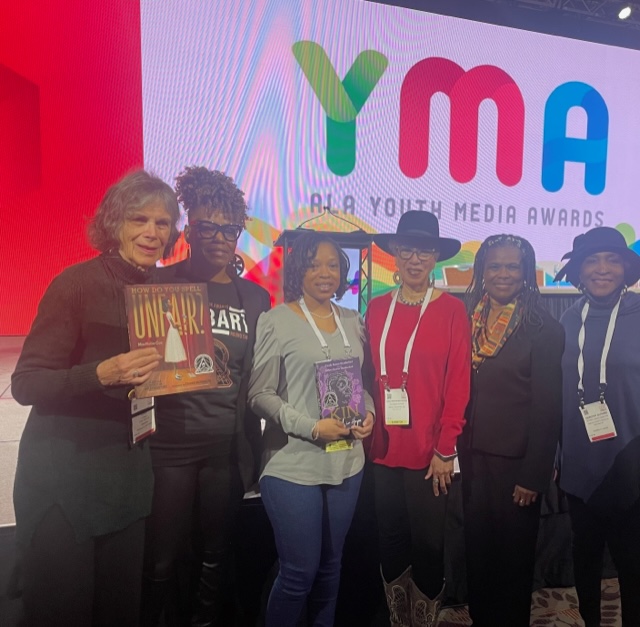
For the first time ever, I attended the American Library Association Youth Media Awards in person. What a thrill to have not one but two books honored. KIN: ROOTED IN HOPE, illustrated by my son Jeffery Boston Weatherford, and HOW DO YOU SPELL UNFAIR? MACNOLIA COX AND THE NATIONAL SPELLING BEE, illustrated by my frequent collaborator Frank Morrison, both won Coretta Scott King Award Author Honors. Thanks to the CSK Award Committee for all the love. And congratulations to all the CSK Award and YMA winners.

This image has an empty alt attribute; its file name is image.png

There were two proud mamas–me and my 98-year-old mother–at the fabulous Reginald F. Lewis Museum book launch and pop-up exhibition for KIN: Rooted in Hope. That event, sponsored by the Roberts Family Foundation, capped our KIN book tour.

In other news, the KIN book tour last fall took us to Baltimore, Salt Lake City, New York, New Orleans and Washington, DC. Not even a library evacuation (bomb scare?) or hurricane could dampen our enthusiasm for sharing KIN, our family’s history, with readers and educators. Thanks to Sankofa Books, King’s English Bookshop, Baldwin & Co. and Books of Wonder for hosting launch events. Our kidlit friends Leah Henderson and Rita Williams-Garcia moderated discussions.

We are excited to be taking KIN home to Easton, Maryland, the verse novel’s setting, on February 23 and 24.

We have several Black History Month appearances planned for Baltimore, Washington, Northern Virginia and Philadelphia. If you are in the DMV or Philly and want to save on travel expenses, we still have openings. Reach out for dates and details.

This leap year adds a day to Black History Month. Rather than cramming Black studies into one short month, use Dawnavyn James’s recent book, BEYOND FEBRUARY: Teaching Black History Any Day, Every Day, and All Year Long, K-3. This instructive guide offers great ideas for using African-American children’s books–including my books, Moses and Unspeakable–in the classroom.

For more on how to approach Black studies, check out Dr. LaGarrett King’s brilliant Teaching Black History Framework. And, download the free annotated bibliography, Black History Books, which compiles links and lesson ideas for books by the Weatherfords.

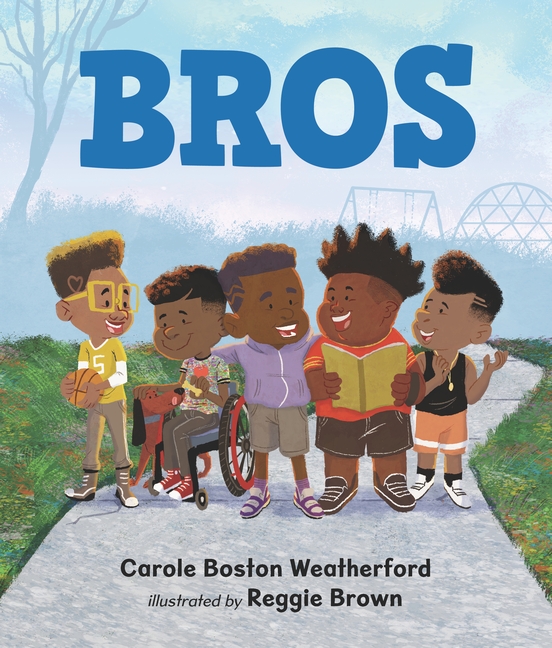
We have several books forthcoming in 2024. The first quarter will see the release of BROS, a poetic picture book celebrating of Black Boy Joy. The book, illustrated by Reggie Brown, is a Junior Library Guild selection. Pre-order BROS now.

Reclaiming History Is Generational Wealth

Art by Jeffery Boston Weatherford from KIN: ROOTED IN HOPE.

October is Family History Month, and true to form, I’m posting one day before it ends. My new verse novel, KIN: ROOTED IN HOPE, is truly a family affair–a family history created by me and my son, illustrator Jeffery Boston Weatherford. The book spans four generations, extending from colonial America to the Jim Crow era. The action is set on Maryland’s largest enslavement plantation and in the all-Black Reconstruction era villages founded by our ancestors.

While my poems conjure ancestral voices and recreate lost narratives, Jeffery’s stunning scratchboard illustrations bring our ancestors, and the adversity they overcame, out of obscurity and life. From plantation ledgers, military records, material culture and the landscape, I learned so much about my forebears, their contemporaries and their milieu. With help from cousins who had done much of the genealogy, I traced my earliest known ancestors, Isaac and Nan Copper, to 1770. Hard as I tried, though, I could not find their/my African origins. When facts proved elusive, I took creative license. Engaging in what scholar Saidiya Hartman terms “critical fabulation,” I pushed past the archive and discovered more than I ever imagined. Here are my key takeaways.

  1. Family is an enduring source of strength.
  2. Names, dates and places form the branches of a family tree. Stories are the leaves.
  3. Reclaiming history is generational wealth. Pass it on!