Carole Boston Weatherford & Jeffery Weatherford, author-illustrator, mother-son duo behind children's and young adult books: diverse, anti-racist nonfiction, biographies, poetry, historical fiction on African American heritage, culture, social justice. STEAM programs for K-12 and all ages.
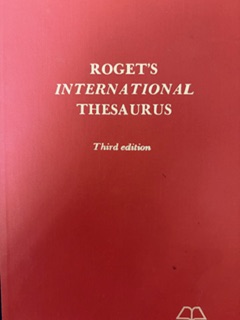
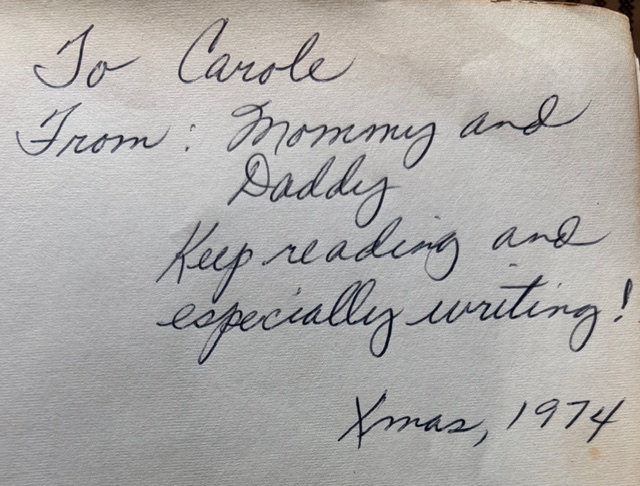
When I was a college freshman, my parents gave me Roget’s Thesaurus as a Christmas gift. The inscription is priceless, perhaps even prophetic. Years later, my father saw my first book published and saw me win a writer’s fellowship. My mother survived him by 27 years and joined me in celebrating each new book and honor.
When my parents became grandparents, they continued the book-giving tradition. Though intended for my children, three such gifts–Afro-Bets ABC Book, Afro-Bets 123 Book and Bright Eyes, Brown Skin; all from Just Us Books)–introduced me to a new, more diverse crop of children’s literature and inspired me to try my hand at writing for young people.
In this season of giving, consider books for the heart, mind, body and soul. My curated collection includes titles for almost anyone on your list.
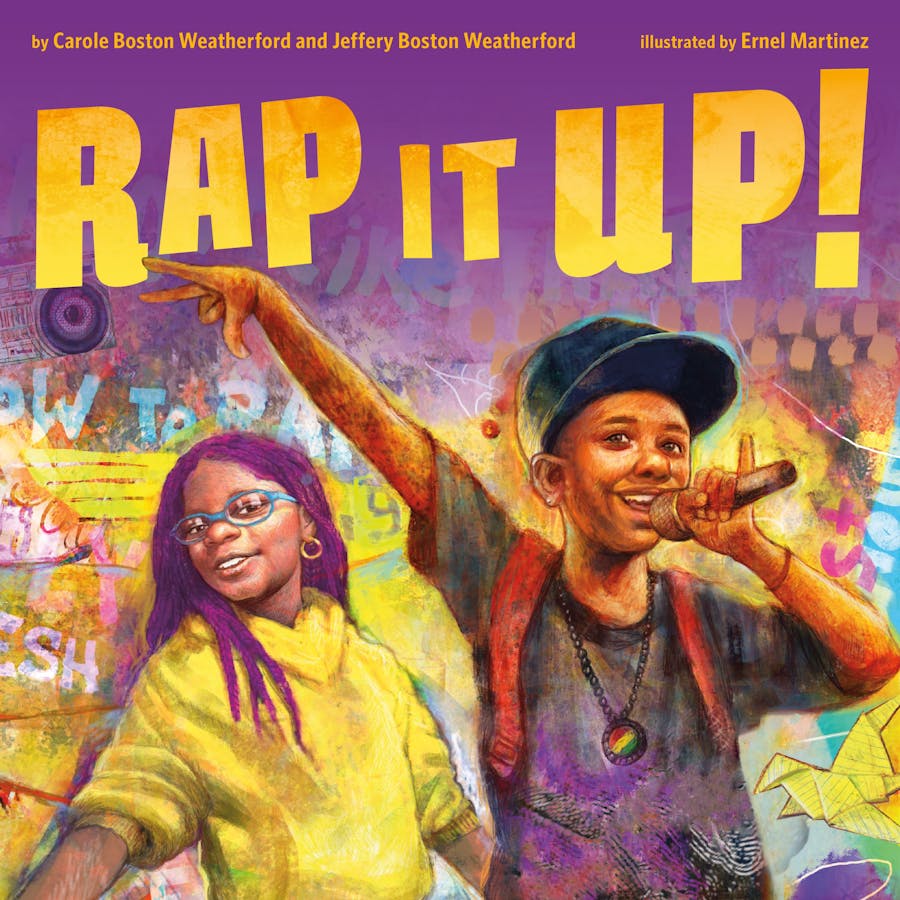
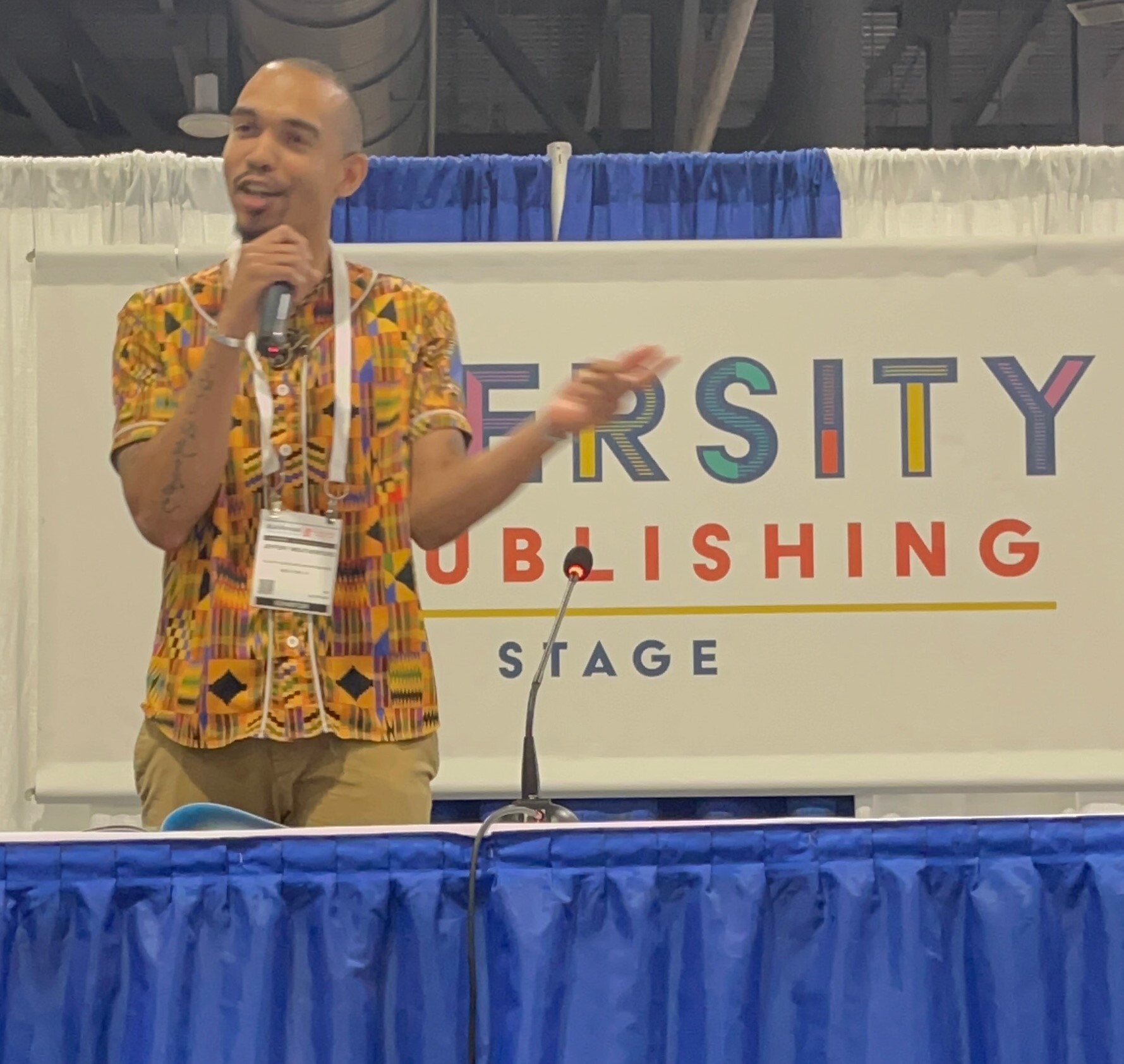
Jeffery spits a few bars from RAP IT UP!, our first co-authored title.
DJ Kool Herc gave birth to the breakbeat at a 1973 back-to-school party in the Bronx. In 1980, I wrote the poem, “I’m Made of Jazz,” which would be my first professional publication credit. Influenced by poetry of the Black Arts Movement, the poem–which came to me out of the blue and fully formed–might have been rap. But I didn’t realize it then. So instead of leaning into hip hop, I set my sights on becoming an author.
Today, hip hop is the language of global youth culture. As an HBCU professor, I created the course, Hip Hop: Poetry, Politics and Pop Culture, which would become the English department’s most popular offering.
Meanwhile, my son Jeffery, not yet a published illustrator, was freestyling and performing every chance he got. Together, we created Hip Hop Tech, a youth residency on writing, producing and performing rap. Jeffery continues to lead these transformative workshops and to spread the gospel of hip hop.
All the while, I was working on my own bars–a picture book manuscript about hip hop history. Published in 2019 and illustrated by Frank Morrison, The Roots of Rap: 16 Bars on the 4 Pillars of Hip Hop, recounts hip hop’s early history and gives props to old school rappers. Download a free teacher’s guide for The Roots of Rap here.
This year saw the release of Rap It Up!, co-authored by me and Jeffery and illustrated by Ernel Martinez. Jeffery’s brainchild, the how-to-book inspires young readers to express themselves creatively and confidently. Chock full of literary terms, the book is an ELA and music teacher’s dream-come-true.
During school visits, we pair these titles in a presentation on the evolution of hip hop. Jeffery never fails to wow the students with his performance of Rap It Up! This program is great for Black History Month, National Poetry Month or even Black Music Month. Contact Carole about bookings.
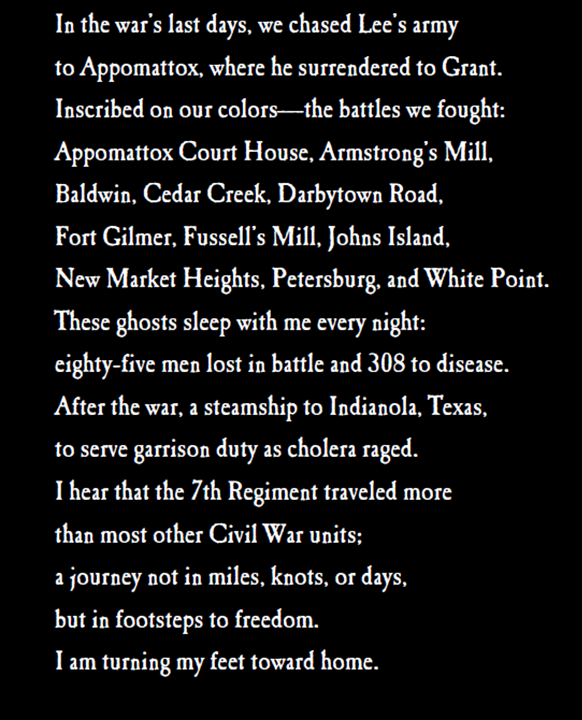
We honor veterans today with Jeffery’s rap tribute inspired by our verse novel, You Can Fly: The Tuskegee Airmen; his illustration of a member of the U.S. Colored Troops; and a poem about our forebear, Isaac Copper, U.S.C.T., from our family history, KIN: Rooted in Hope. To all veterans: Thank you for your service!
We’ve got a few more appearances before the holiday season: Arlington, Virginia; Pittsburgh, Pennsylvania; Washington, DC for the African American Civil War Museum Descendants Conference; and Denver, Colorado for National Council of Teachers of English conference. NCTE meets the week before Thanksgiving, so I’m planning ahead for my family feast. I’m prepping not only for the big meal but also to keep bellies full all weekend. These recipes are among my faves. What’s cooking at your house? Share in the comments section below.
How fitting that our One Maryland One Book (OMOB) tour for Kin: Rooted in Hope coincided with Family History Month and Banned Books Week. Kin traces our family’s lineage to 1770 on the largest enslavement plantation in Maryland and to two all-Black Reconstruction era villages that they co-founded. Jeffery and I collaborated on the book in a quest that culminated with this epiphany.
Knowing your history is generational wealth.
The OMOB tour began at Riversdale House Museum in Riversdale, Maryland with a pop-up exhibition of Jeffery’s art from the book juxtaposed with furniture and artifacts throughout the one-time plantation. Together, we discussed the book and shared favorite poems.
The next stop was Chesapeake College in Wye Mills, Maryland on the Eastern Shore where the book is set. My dear friend, Harriette Lowery, a co-founder of the Frederick Douglass Honor Society, moderated the discussion which was livestreamed. A record crowd greeted us. We appreciate all the love.
Our busiest day–on Maryland’s Western Shore–included stops at the College of Southern Maryland in La Plata and St. Mary’s College of Maryland in St. Mary’s City. The reception at the College of Southern Maryland featured such local delicacies as quick-pickled watermelon rind. Delish! Here’s a recipe.
We ended the week at Morgan State University in my hometown–Baltimore. Thanks to the Department of English and Foreign Languages and new chair Dr. DeMaris Hill for hosting our appearance.
Although our official tour wrapped up, discussions of Kin continue across the state. Jeffery and I attended the Berlin Book Festival (Maryland, not Germany!). Berlin was the birthplace of the subject of By and By: Charles Albert Tindley, the Father of Gospel Music, my first collaboration with Bryan Collier. I dropped in on a book club meeting at Edenwald senior living community in Towson, and we both spoke at the Maryland Lynching Memorial Conference at the Reginald F. Lewis Maryland Museum of African American History and Culture.
We’re eager to discuss Kin in secondary schools and with book clubs. Download the Kin reading guide here.
Mark Twain’s words resonate with me not because I am a poet and a history buff but because today’s headlines sometimes feel ripped from the past. My poetic books on historical subjects help young readers connect the dots between past and present. Thus, the poems below from Jesse Owens: Fast Man Alive and Outspoken: Paul Robeson, Ahead of His Time–A One-Man Show could not be more timely. Both books are illustrated by my frequent collaborator, Eric Velasquez. Jesse Owens is set during the 1936 Berlin Olympics when Nazism was on the rise. Outspoken is a full biography of entertainer and activist Paul Robeson, who was blacklisted and barred from performing after testifying before the House Un-American Activities Committee in the 1950s.
You are not meant to see the concentration camps that hold free-thinking souls who dared to challenge Hitler’s rise. *** This is not war–not yet.
From JESSE OWENS
You want to shut up every Negro who has the courage to stand up and fight for the rights of his people, for the rights of workers.
From OUTSPOKEN
Download a free teachers guide for Outspoken here.
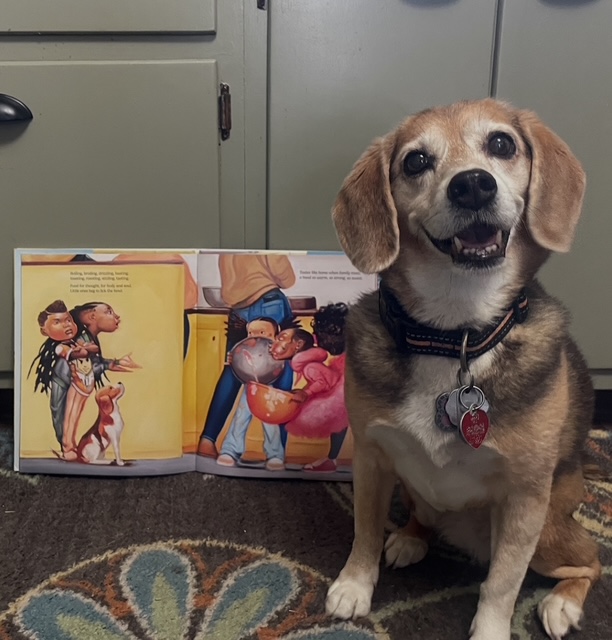
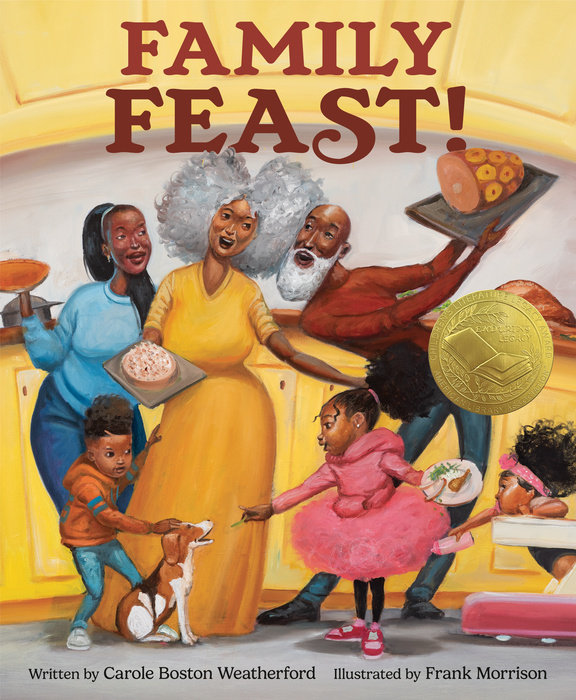
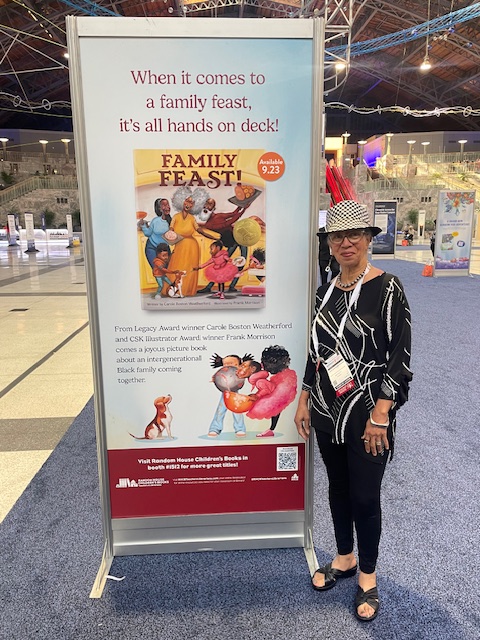
My Gigi makes her picture book debut in Family Feast. Thanks, Frank Morrison, for putting my sweet girl in our book.
They’re not twins, but they do share a book birthdate. And they are both bundles of joy!
Family Feast, another collaboration with illustrator Frank Morrison, celebrates the customs, conversation, chaos and culinary delights that make family gatherings unforgettably fun. Like my dog, Gigi, the beagle in Family Feast is ever hopeful for treats from the table.
Grind: An Ode to Skateboarding, illustrated in street-art style by Néstor Omar García López, celebrates one of the first extreme sports. The book draws on memories of my days as a skateboard-mom. Since the 1990s, hip hop has had a huge influence on hip hop–which brings me to another bit of news.
A Book Pairing for King Holiday Programs
Be a King: Dr. Martin Luther King, Jr.’s Dreamand Youand Rap It Up! are both rooted in African-American oral traditions. Dr. King hailed from the Black church, where call-and-response enlivens worship services. Rap It Up!, a how-to book, encourages youth to seize the power of their voices. Based on these compelling titles, our newest presentation for grades 2-6 connects the Civil Rights Movement and hip hop culture as students chant refrains and sing 1960s protest songs. We look forward to presenting this exciting new program at schools like yours. Contact us soon to book this program for January or February.
Are you old enough to remember blackboards, chalk and dusty erasers? The teacher would enlist a student to wipe the blackboard so the next day began with a clean slate.
Well, history doesn’t work that way. The past is blood running through our veins, a wound festering in our heartland and a scar on our democracy. To heal, we must come clean. That means chronicling a truer and more complete history.
For three decades, I have spoken truth to young scholars and reclaimed lost or little known narratives from painful chapters of American history. Imagine my outrage that Black history is now being erased or, at best, revised to suit a regressive, repressive and oppressive agenda.
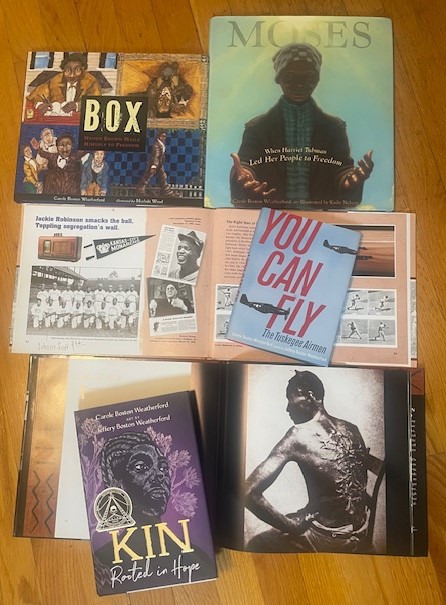
These books from my backlist touch on subjects targeted by current culture wars:
Moses: When Harriet Tubman Led Her People to Freedom, ill. by Kadir Nelson (Harriet and enslavement)
Box: Henry Brown Mails Himself to Freedom, ill. by Michele Woods (enslavement and the Underground Railroad)
A Negro League Scrapbook (Jackie Robinson)
You Can Fly: The Tuskegee Airmen, ill. by Jeffery Boston Weatherford (the Airmen)
Kin: Rooted in Hope, ill. by Jeffery Boston Weatherford (enslavement)
Remember the Bridge: Poems of a People (Out of Print–photo of Peter-Gordon with scarred back)
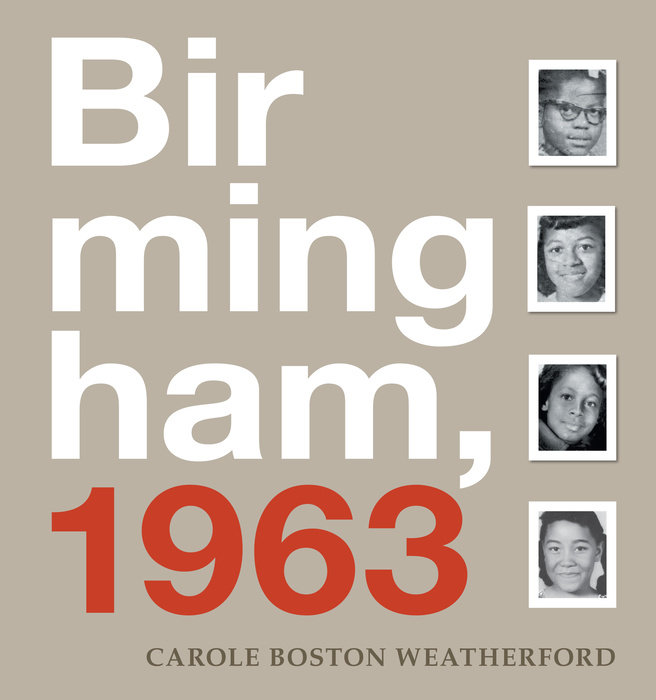
On September 15, 2963, the Ku Klux Klan bombing of Sixteenth Street Baptist Church killed four girls: Denise McNair, Addie Mae Collins, Carole Robertson and Cynthia Wesley. Birmingham, 1963 is an elegy to the girls whose lives were cut short.
In this work of historical fiction, an unnamed narrator is marking her tenth birthday. Sadly, that milestone is marred by violence. The book’s longer opening poem precedes four short “In Memoriam” poems–incantations, spotlighting the four girls’ pastimes, personalities and passions and speculating who they might have become. In May 2013, the four girls were posthumously awarded Congressional Gold Medals.
In the 1960s, Birmingham was one of the most racially divided cities in the United States. While civil rights protesters pressed for equality and integration, the staunchest racists resorted to violence to resist change. Racists set off so many bombs in Birmingham’s Black neighborhoods that the city was nicknamed “Bombingham.” Led by the Reverend Fred Shuttlesworth, Sixteenth Street Baptist Church was the hub of the city’s Civil Rights Movement, known as the Birmingham Campaign. The Reverend Martin Luther King, Jr. was jailed after marching from the church on April 12, 1963 and would go on to write his eloquent “Letter from Birmingham Jail.” And the historic Children’s March took place on May 2, 1963 in downtown Birmingham.
The bombing of Sixteenth Street Baptist Church seared the collective conscience. The hate crime both shocked and shamed America. During the Cold War, America offered itself as a beacon of freedom and democracy. Yet, systemic racism persisted and white supremacists terrorized African-American citizens. The church bombing laid bare those moral contradictions.
In 1963, I was seven years old and had already written my first poem. At the time, my parents did not share news of the bombing with me. I grew up in Baltimore and did not experience the degree of discrimination that they did in Birmingham. In many ways, I was those girls. Like Addie Mae Collins, I drew portraits, played hopscotch and wore my hair pressed and curled. Like Cynthia Wesley, I was a mere wisp of a girl who sometimes wore dresses that my mother sewed. I sang soul music and sipped sodas with friends. Like Denise McNair, I liked dolls, made mud pies and had a childhood crush. I was a Brownie, had tea parties and hosted a neighborhood carnival for muscular dystrophy. People probably thought I’d be a real go-getter. Like Carole Robertson, I loved books, earned straight A’s and took music and dance lessons. I joined the Girl Scouts and was a member of Jack and Jill of America. I too hoped to make my mark. We are both Caroles with an “e.”
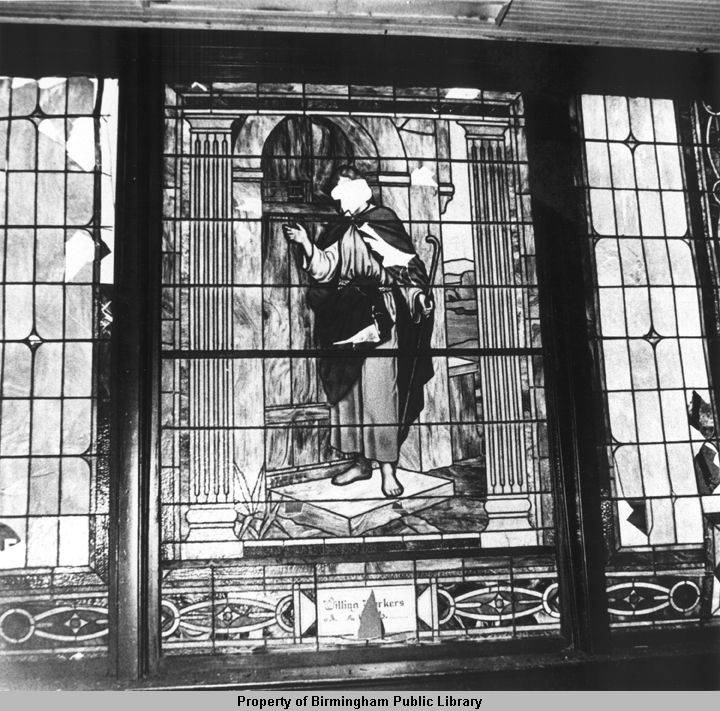
In researching the Birmingham, 1963, I was surprised that a stained glass window of Jesus almost survived the blast intact.
10:22 a.m. The clock stopped, and Jesus’ face
Was blown out of the only stained glass window
Left standing—the one where He stands at the door.
How ironic that Jesus was left faceless—as if He couldn’t bear to witness the violence.
At the four girls’ funeral, Dr. King delivered the eulogy. He called them “martyred heroines of a holy crusade for freedom and human dignity.”
What a summer! Jeffery’s performance of Rap It Up! at the Children’s Defense Fund (CDF) Freedom Schools National Training in Knoxville, wowed the crowd and led a CDF staffer to proclaim him “the read-aloud GOAT.” Jeffery presented a virtual Rap It Up! workshop for New York’s Valley Cottage Library.
His solo exhibition of prints from Kin: Rooted in Hope appeared at the Academy Art Museum in Easton, Md. We celebrated Juneteenth at separate events in Easton and Centreville, Md. I served as writer-in-residence for the Children’s Literature Program at Hollins University in Roanoke, Va.
Together, we keynoted the Children’s Literature Conference at Texas Christian University and presented at Houston Public Library locations.
At the American Library Association conference in Philadelphia, we signed lots of books, presented on the Diversity Stage and shared the joy as I received the Children’s Literature Legacy Award. I was blessed to have my family and my agent, Rubin Pfeffer, with me at the Newbery/Caldecott/Legacy Awards Banquet. Read my acceptance speech here. The ALA conference is more than a big show; it’s a reunion with librarians and our creative peers.
The biggest news of the summer is not at all literary: Beah Rainbow Weatherford was born to Bre’Anna and Jeffery Weatherford on July 15. Perhaps, she’ll inspire or appear in our books. Her cousins Jordin (on the cover of Kin) and Cara (in an upcoming book) have already made their cameos. For now, they’re back to school.
Our 2025-2026 school presentations link to the English/language arts, social studies, STEAM, physical education, and SEL curricula and feature these acclaimed books and pairings:
We are currently developing a teachers’ guide for Rap It Up! We’d love to hear how you have used rap in your classroom. Please share in the comments below.
We’ll be touring Maryland in October to discuss our book Kin: Rooted in Hope, the 2025 One Maryland One Book selection. The common read constitutes Maryland’s biggest book club. We’re honored that Kin will be read widely.
In 1995, my first book, Juneteenth Jamboree, was released by Lee and Low Books. At the time, it was the first and only children’s book on the first African-American holiday. I did not imagine then that I would still be publishing books 30 years later. But, 70-some books later, I am still here and I am filled with gratitude. I appreciate all the parents, caregivers and teachers who have shared my books with children in homes and classrooms across the U.S. I am grateful that children are provoked to ask tough questions after reading my nonfiction books such as Unspeakable: The Tulsa Race Massacre, Freedom on the Menu: The Greensboro Sit-ins, Birmingham, 1963 and How Do You Spell Unfair? Macnolia Cox and the National Spelling Bee. I am grateful for all the schools and libraries that have sponsored my author visits. I am tickled that babies sleep with, and toddlers beg their parents to read, my board books or rhyming texts like Jazz Baby and the newly released When I Move. And I am grateful to all the award juries that chose to honor my books.
I am eternally grateful that my mother had the foresight to stop the car to jot down the original rhyme that I recited on the ride home from first grade. I am grateful that my father used my poems as typesetting exercises for the students in his printing class at Frederick Douglass High School in Baltimore. I am grateful that my son, illustrator and rapper Jeffery Boston Weatherford, has collaborated with me on four books, especially KIN: Rooted in Hope, a family history that received more love than I ever dreamed.
I am grateful that motherhood led me to my local library for storytimes that introduced me to a new crop of diverse children’s books which inspired me to try my hand at writing for young people. Last but not least, I am grateful for my ancestors who endured so that I could not only have a life but also build a legacy. THANK YOU!